How To Release Trauma from the Body
Updated: Jul 21
Working as an integrative trauma therapist, I often am asked “How can I get past ___?” Or “Is there any way to help it feel less HEAVY?!” Or “I don’t like feeling stuck back there. How can I be more present?”. The answers to these questions are often complex and range between individuals. However, I do have a few tools to share that seem to help most of my clients feel even 10% better.

What do we mean by 'trauma'?
First, let’s orient ourselves to what do we mean when we are saying “trauma”.
If you check out the American Psychological Association website, you will find trauma defined as “Any disturbing experience that results in significant fear, helplessness, dissociation, confusion, or other disruptive feelings intense enough to have a long-lasting negative effect on a person’s attitudes, behavior, and other aspects of functioning.”. They go on to state that traumas can be at the hands of other humans or nature and that traumas often challenges beliefs of safety, justice or predictability in the world.
Woof, that last part hits, right?
But what happens after can feel rude and honestly disruptive. The brain fog, vivid dreams, urges to numb yourself, mood swings, feeling disconnected from yourself and your life. It’s all your body trying to make sense of shifting from survival to living again. The more developed parts of the brain trying to come back online fully and understand what the heck actually happened. This shift can be more challenging for those with limited access to resources, higher rates of childhood abuse or neglect, or actively in addiction. More challenging does not mean impossible, but will often require specialized care.
I like to address what happens in the body physiologically in my work with clients. When the fire alarm of the brain (amygdala) alerts that there is danger afoot, the more developed parts of the brain go offline so that the survival brain (limbic system) can respond as quickly as possible. It’s a beautiful, robust system that has kept our species alive for many moons. However, when this system is relied upon chronically with no hopes of the perceived danger dissipating, it becomes sensitive- learning to react faster, get triggered more easily, and staying on hyper-alert for any sources of danger.
Trauma on a spectrum
Many therapists learn about “little t traumas” vs. “big T traumas”. To explain the difference, let's look at an example:
An 11-year-old child named Cherry lives in a home with her mother and father. 2 months ago, Cherry and the family dog, Penny, were playing out in the yard when Penny tragically ran into the road and was struck by a car. Since Penny’s death, Cherry has experienced nightmares, intrusive thoughts and images, mood instability, and uncontrollable tearfulness. As she continues attending school, she starts feeling isolated from a group of friends that she was previously close with. Many of her previously close friends don’t “get” Cherry’s grief and have felt uncomfortable around her. When she would previously eat lunch with her friends, now she eats alone lost in her thoughts.

The “big T” in this scenario is the traumatic death of the family dog, Penny, that Cherry witnessed. “big T” traumas are characterized by significant, sudden, and often violent events negatively impacting one’s physical, mental, and spiritual health. Some examples of “big T” traumas are sudden/traumatic loss, war, natural disasters, witnessing violence, and assault.
The “Little t” in this scenario is the social isolation and changes in social dynamics Cherry notices at school. “Little t” traumas are typically repeated disturbing experiences that lead to poor mental and even physical health. While “little t” traumas are often not a threat to physical wellbeing, the cumulative effects of these traumas can be disastrous. Some examples of “little t” traumas include bullying, grief related to non death losses, and some cases of emotional abuse.
Trauma diagnoses can range from acute trauma reactions which typically decrease within one month following the event to chronic or complex trauma that debilitate many areas of one’s life and symptoms may be lifelong if left untreated. The best way to navigate your individual trauma journey is to get the support of a trauma-informed therapist, psychiatrist, reiki worker, masseuse, spiritual leader, etc. Whether it's one or developing a team, having an educated support system is vital.
Releasing Trauma
Before we dive into the tools, I want to set some realistic expectations. These tools won’t erase the symptoms of trauma from your body. Bummer, right? However, these tools can be solid skills to add to your toolbox while trying to navigate your journey in the “after” of trauma.
TIPP: Temperature, Intense Brief Movement, Paced Breathing, and Progressive Muscle Relaxation

The first skill that we are going to get into comes from Dialectical Behavioral Therapy (DBT) which focuses on helping people learn to tolerate their emotions- “riding the wave” of their feelings. Accepting how the energy of emotions ebbs and flows, learning not to assign meaning to these changes and practice being the observer of them instead.
DBT loves an acronym so we begin with T, standing for temperature. Cold temperature can shock the nervous system and bring us back to a more regulated state. Ideally, fill up a large mixing bowl with cold water and then add ice. Now, dip the entirety of your face into the bowl and hold it there for as long as you can (from 5-30 seconds) (if you feel lightheaded or pain- stop). If you don’t have access to a full mixing bowl of cold water, putting cold running water on your face can work in a pinch. I have also had clients freeze citrus fruits to smell and hold to use cold temperature as a grounding skill.
Next, we practice intense brief movement to elevate the heart rate, momentarily causing more discomfort. Once you stop the intense movement your heart rate will naturally decrease, training your nervous system that YOU are capable of changing how you feel in your body and not powerless to it. Some examples of brief movement are throwing a pillow, throwing yourself on your bed repeatedly, running in place, wall push ups, dancing, thrashing your arms and legs, jumping in place, shaking out your arms and legs energetically, etc.

Now, we refuel our body with paced breathing. Paced breathing involves having some sort of count to your breath. The most common paced breathing exercise is called a “box breath” where each count is 4. Inhale for 4 seconds, hold your breath for 4 seconds, exhale for 4 seconds, then hold your breath for another 4 seconds. This is a helpful exercise introduction to paced breathing. If you are feeling very anxious in your body (hyperaroused), it may be helpful for you to make your exhales longer than your inhales. This magic trick tells your more developed parts of your brain to come back online. Think about when you are scared- you gasp and hold your breath. Think about when you are relaxed- you sigh and breathe easy. The pace for this breathing exercise is 4-7-8. Inhale for 4, hold your breath for 7, and exhale for 8. This exercise can be challenging for those who are new to paced breathing or having chronic hyperarousal. Breathing in through the nose and out through the mouth slowly is your best bet here!

We end this skill with progressive muscle relaxation. The thought behind this skill is attuning to and noticing what different parts of your body feel like when they are tense and relaxed. Progressive muscle relaxation can be done informally by tensing and releasing a part of the body or formally by listening to someone lead you through a full body progressive muscle relaxation script. We begin by noticing how your toes feel naturally in your shoes, observing the sensations like cool, warm, tingly, etc. Next, you squeeze your toes as tightly as you can for 5 seconds and then release. Notice how the area may now feel different like more spacious, active, fluid, etc. I will add some resources for progressive muscle relaxation scripts at the end of this post.
Somatic Exercise: Rainbow Scanning
This exercise is based off of something called the “Polyvagal Reset”. Polyvagal refers to the Vagus Nerve which is sometimes referred to as the “soul nerve” and has a bunch to do with regulating our nervous system. More on the Polyvagal theory in future blog posts! The thought behind the polyvagal reset is rooted back in the “caveman” days. When we were more of hunter/gathers, we would scan the horizon to search for danger and ensure our safety. A polyvagal reset is a very simple exercise where we bring our chin to one shoulder (almost looking over your shoulder) and slowly scanning along your eyesight until you reach your other should. I encourage clients to deepen their polyvagal resets by adding paced breathing at the beginning or end of their sets.
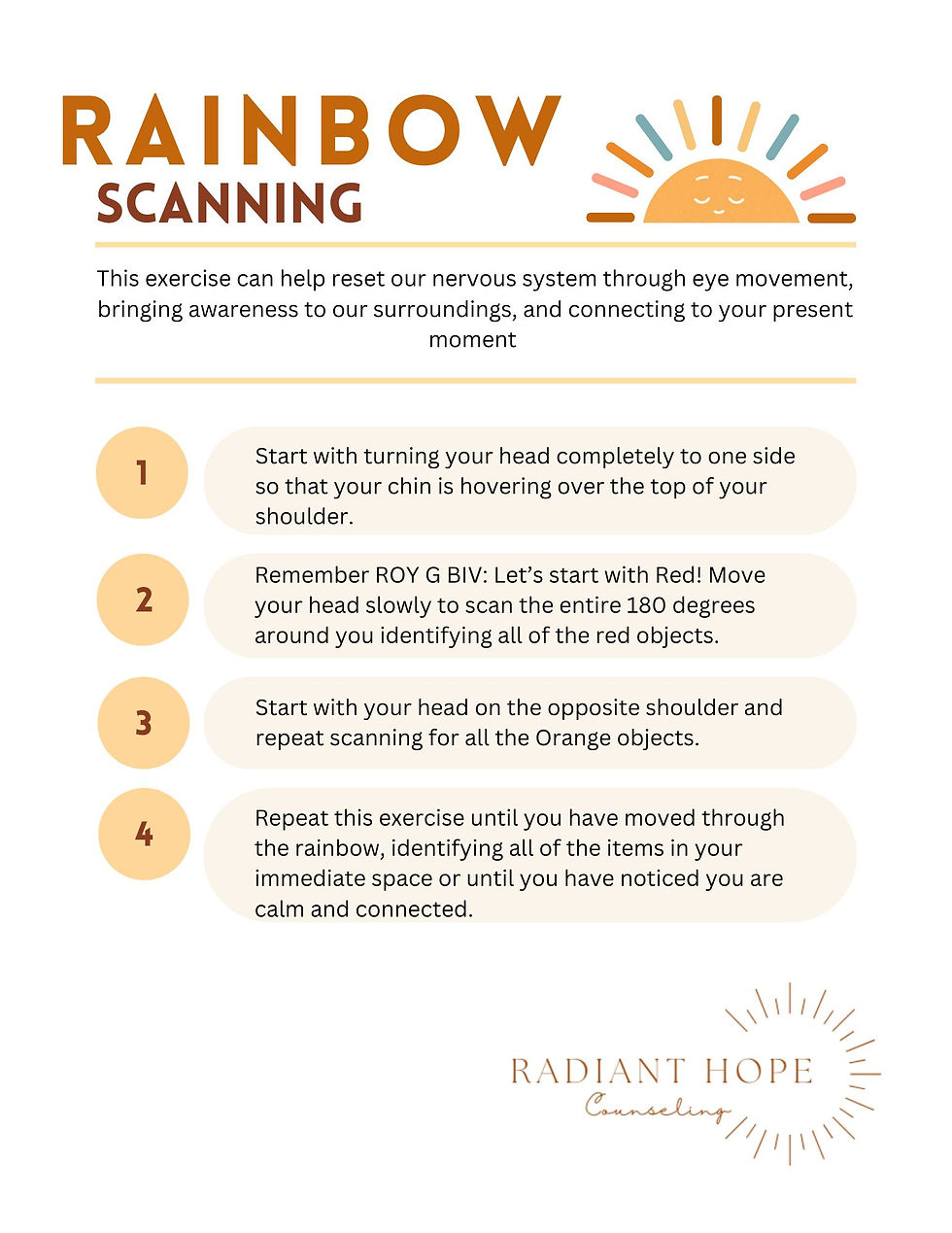
Let’s make it a Rainbow Scan! So everything is the same but with each scan you will notice items of a certain color. Thank goodness for all the teachers who taught me ROY G BIV! Your first scan will be all of the red objects that you can find. Once you reach your other shoulder, take your breath and get ready to find all of the orange objects next. And so on and so forth. Keep your scan moving smoothly and don’t focus too much on finding all of the objects. This is just giving you more of a grounding tool while we are doing the polyvagal reset.
Getting the most out of your tools
These tools alone may be enough to support mild anxiety or an acute trauma response. I cannot emphasize the importance of supporting the symptoms of trauma with a trauma-informed team. A therapist, psychiatrist, reiki practitioner, coach, pastor/priest/spiritual guider, etc. The difference between bearing the weight of trauma alone versus having educated, understanding people surrounding you is life-changing.
So where do I start?
If you are currently involved in a community that may support you, start here! Remember your friends, church, family, gaming buddies, school counselor, book club, bandmates, etc.? If it feels possible and safe for you, schedule a meeting with your advisor and see if they have any resources for you. Meet with your pastor and see if they have any counsel. Ask your friend if she is able to help you find a good therapist because finding one yourself feels impossible.
While seeking out your team of people, the following questions may be helpful:
“What is your experience working with people who feel like I do?”
“Can you tell me a little bit about your training when it comes to trauma or PTSD?”
“What is your approach in treating (or supporting those with) trauma?”
“What type of preparation work will we do before addressing my trauma symptoms?”
"How many clients are you currently seeing and what are you doing to care for yourself?"
Evidence backed treatments for trauma include Cognitive Behavioral Therapy (CBT), Cognitive Processing Therapy (CPT), Prolonged Exposure (PE), Eye Movement Desensitization and Reprocessing (EMDR) and medication management. If you see that someone is trained (or even better yet certified) in one of these treatment methods, they may be of great help to you. I typically seek out my referral options on Psychology Today.
Conclusion
Trauma can be a debilitating experience for some depending on a myriad of factors. Regardless if the trauma is a “little t” or a “big T”, having tools to help attune to symptoms of trauma and regulate the nervous system are vital. The TIPP skill and Rainbow Scanning are valuable tools that if practiced repeatedly build new neural networks in the brain that promote presence, peace, and regulation.
As an EMDR certified therapist, I offer weekly EMDR sessions or intensive models which can accelerate trauma processing for some clients. If you are interested in learning more about EMDR as a client or fellow therapist, the EMDR intensives, or getting on my caseload; reach out for a consultation today.

Comments